A trusted hub for rare disease. Vetted, cited, and connected.
CodeRare brings the rare-disease community onto one trusted record. Every disease profile is sectioned, sourced, and dated. Every fact carries a citation you can follow back to its origin. Patients track their conditions across the long diagnostic journey that rare disease tends to involve. Medical professionals get vetted clinical content and earn continuing education credits. Partner organizations curate the knowledge their communities depend on, and the AI assistant answers only from what has been verified.

Three communities. One trusted record.
Rare disease only works when the people closest to it can find each other. CodeRare is built around the three communities whose work overlaps every single day, and gives each one the surface they need without compromising the others.
The Rare Model of Care Knowledgebase.
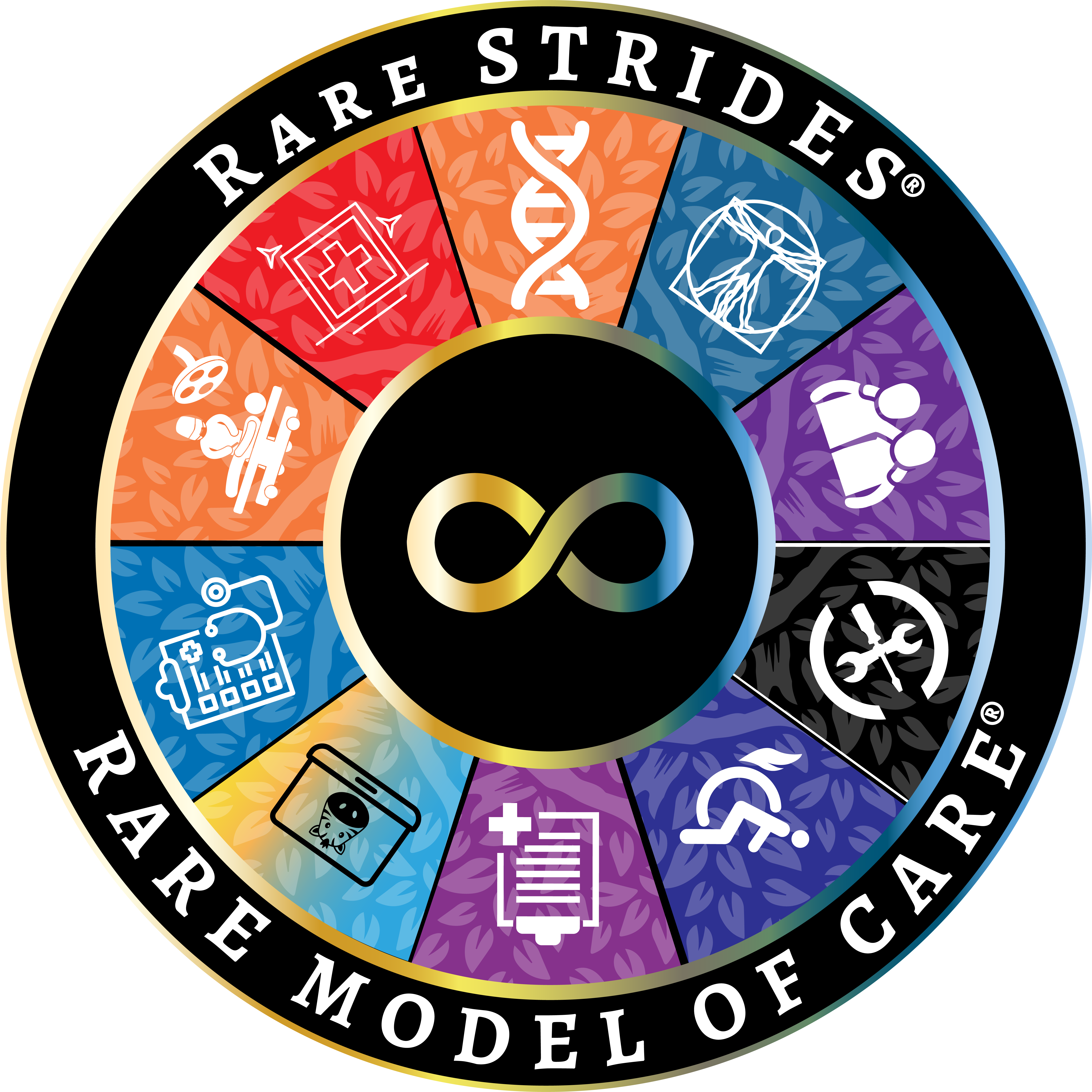
CodeRare's knowledgebase is built around the Rare Strides Rare Model of Care, the framework that maps the full arc of how rare disease is lived, diagnosed, treated, and supported. Every disease profile is sectioned, sourced, and dated, with each section tied to the slice of the Model of Care it speaks to. Symptoms. Genetic factors. Modifying factors. Diagnostic tests. Treatments. Publications. Disease history. Resources. Each section carries its own dated review and its own citations, so a reader can always see who said what, when they said it, and where to read it for themselves.
Sources themselves are scored. A peer-reviewed journal article, a government disease registry, and a personal blog post are not the same kind of evidence, and the credibility model says so out loud. Reputation tiers and document types feed a transparent score, so the badge you see next to a fact actually means something.
An assistant that only answers from what has been verified.
Most AI tools guess. CodeRare's assistant doesn't. Every question routes through a two-pass grounded retrieval against the vetted knowledge base, and every answer carries the citations behind it. If the knowledge base doesn't know, the assistant says so plainly and never invents a clinical claim to fill the silence.
Private by design
Your conversations with the assistant are private to your account. They are not used to train upstream models, sold, or shared. Anonymous data ingestion stops at the chat boundary.
Agentic, with a verifier
A coordinator agent routes each question to specialists. A separate verification pass checks each claim against its citation before the answer is shown, so hallucinated facts have nowhere to land.
Grounded in the knowledge base
Every clinical claim is retrieved from the same knowledge base medical professionals vet. The assistant cannot pull from open web content or unverified sources mid-answer.
Citations on every answer
Every fact in a response carries a clickable citation back to the original record. If a citation is missing, the assistant flags the gap rather than papering over it.
Vetted by clinical reviewers
The underlying knowledge base is reviewed by nurses and other medical professionals through the RareStrides Strides Stat program, and re-vetted on a regular cycle so the answers stay current.
Polite refusals beat false confidence
Out-of-scope or under-cited questions return a clear "I don't have a vetted answer for that" rather than a fabricated one. Refusal is a feature, not a bug.
Lessons authored by experts. Vetted by CodeRare. Credited to clinicians.
CodeRare's CME platform is structured around how rare-disease education actually gets built. Partner organizations author the lessons because they are the institutional experts. CodeRare vets the lessons because cross-org review is the only way to keep the catalog credible. Clinicians earn credit because their time is real and worth tracking.
Each lesson is built from video, slide, and quiz parts. Lessons compose into modules, modules award badges, and every step is tied to the learner's account so the trail of completed work travels with them. A two-step publish flow keeps editorial control with the authoring organization while CodeRare handles the vetting and the dated re-vet cycle that follows.
- Video, slide, and quiz part types out of the box
- Two-step publish flow: org approval, then CodeRare vetting
- Vetting re-checks every six months so the catalog stays current
- Badges and credits travel with the learner across modules
HIPAA-shaped from the data model up.
CodeRare handles Protected Health Information, so the patient health record is built on the same principles that drive the rest of the RareStrides platform. Sharing is patient-controlled, every access is audited, and administrative roles do not get an implicit back door into clinical data.
Patient-controlled sharing
- Grant access to specific record slices, not the whole chart
- Time-bound grants that expire on a date you choose
- Revoke any grant at any time, no questions asked
- You see who looked at what and when, every time
Audit on every read
- Every PHI read writes a log row in the same transaction
- Administrative actions are recorded in a separate activity log
- CodeRare administrators have no implicit access to PHI
- Reads, writes, and undos are all attributable to a real user
Defense in depth
- Role-based access control on every endpoint
- TLS for every connection, JWT for every authenticated call
- Input validation against SQL injection, XSS, and CSRF
- FHIR-aligned data model so records survive system migrations
CodeRare is one part of RareStrides.
RareStrides connects patients, NGOs, and clinicians around rare disease. CodeRare is the trusted-information layer inside that ecosystem. The broader RareStrides programs add the human review and community engagement that make the data trustworthy in the first place.
Strides Stat brings clinical reviewers, nurses and other medical professionals, into the loop to vet knowledge-base facts, validate CME content, and over time triage patient-entered observations directly inside the record. The content you see on CodeRare is the durable expression of what those reviewers approved.
Ready to start?
Register to track your health, follow rare-disease research, and connect with the organizations and clinicians working on what you care about. Already a partner organization? Get in touch and we will help you onboard.